Paper: GS-II, Subject: Governance, Topic: Government Policies, Issue: India’s Complete Semiconductor Ecosystem
Context
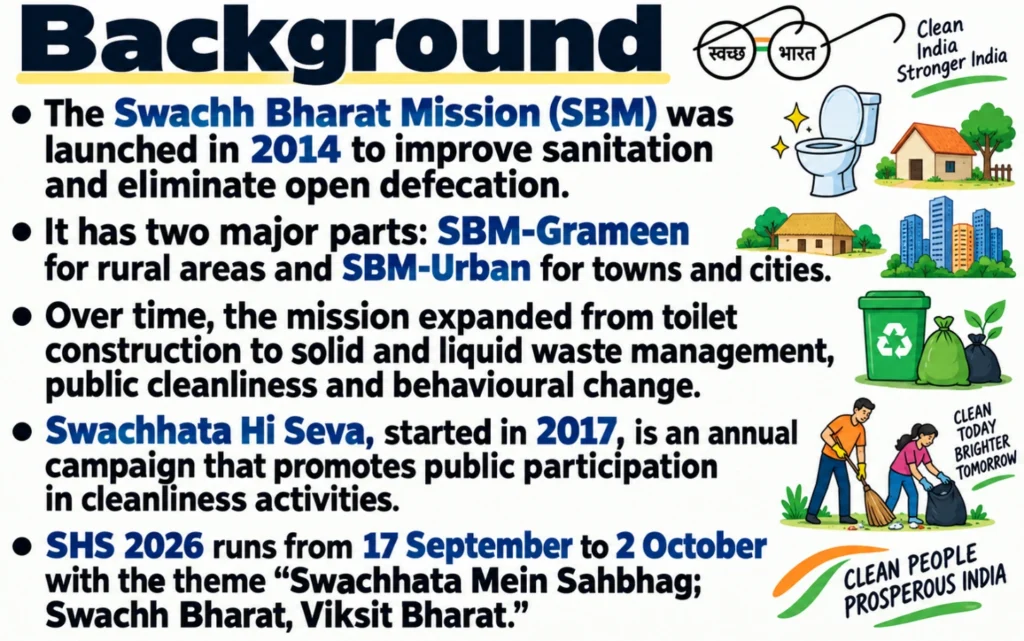
India’s cleanliness programme is no longer only about building toilets or conducting occasional cleaning drives. The focus is increasingly shifting towards waste management, clean public spaces, hygiene and behavioural change. Swachhata Hi Seva (SHS) 2026 seeks to make cleanliness a shared responsibility involving citizens, governments, schools, institutions and sanitation workers.
What Is the Focus of SHS 2026?
1. Cleaning Neglected Public Places
- The campaign identifies Cleanliness Target Units (CTUs).
- These are places such as garbage dumps, dirty public spaces and locations that repeatedly become unclean.
- Such places are cleaned, beautified and brought under regular maintenance.
- Markets, schools, hospitals, parks, transport hubs and water bodies are also covered.
- Citizens can report sanitation problems through digital platforms such as the Swachhata App.
2. Making Young People Part of the Solution
- Students and youth are involved through Swachh Paathshala.
- Students can visit sanitation and waste-management facilities to understand what happens to waste after it leaves their homes.
- Schools also promote awareness regarding: handwashing, personal hygiene, water conservation, menstrual hygiene & and safe drinking water.
3. Protecting SafaiMitras
- SafaiMitras are sanitation workers involved in cleaning streets, drains, toilets and other public spaces.
- Special camps provide them with: health check-ups, safety equipment, access to welfare schemes, and better awareness of occupational safety.
- The basic idea is that a cleanliness campaign must also protect the health, dignity and safety of sanitation workers.
4. Citizen Participation
- Cleanliness cannot be left only to municipal workers. Citizens are encouraged to: avoid littering, separate wet and dry waste, compost biodegradable waste, reduce single-use plastic, and keep neighbourhoods clean.
- Community rallies, cleanliness pledges and voluntary drives are used to build public participation.
5. Turning Waste into a Resource
- SHS promotes the 3Rs — Reduce, Reuse and Recycle.
- Kabaad Se Jugaad encourages useful products from waste materials.
- Kabaad Se Kala promotes converting waste into art.
- This supports a circular economy, where materials are reused instead of simply being thrown away.
Conclusion
The central idea of Swachhata Hi Seva 2026 is simple: cleanliness should become a daily habit, not an occasional government campaign. Its success depends on combining sanitation infrastructure with citizen participation, responsible waste management, youth involvement and dignity for sanitation workers.
Source: (PIB)
La Excellence IAS Academy, the best IAS coaching in Hyderabad, known for delivering quality content and conceptual clarity for UPSC 2026 preparation.
FOLLOW US ON:
◉ YouTube : https://www.youtube.com/@CivilsPrepTeam
◉ Facebook: https://www.facebook.com/LaExcellenceIAS
◉ Instagram: https://www.instagram.com/laexcellenceiasacademy/
GET IN TOUCH:
Contact us at info@laex.in, https://laex.in/contact-us/
or Call us @ +91 9052 29 2929, +91 9052 99 2929, +91 9154 24 2140
OUR BRANCHES:
Head Office: H No: 1-10-225A, Beside AEVA Fertility Center, Ashok Nagar Extension, VV Giri Nagar, Ashok Nagar, Hyderabad, 500020
Madhapur: Flat no: 301, survey no 58-60, Guttala begumpet Madhapur metro pillar: 1524, Rangareddy Hyderabad, Telangana 500081
Bangalore: Plot No: 99, 2nd floor, 80 Feet Road, Beside Poorvika Mobiles, Chandra Layout, Attiguppe, Near Vijaya Nagara, Bengaluru, 560040