
Paper: GS – III, Subject: Economy, Topic: Trade and External sector, Issue: Growth of Agricultural Exports Amid Protectionism.
Context:
India’s agricultural exports recorded moderate growth in 2025–26 despite higher tariff barriers and protectionist measures imposed by the United States. Indian farm exports diversified toward alternative global markets and high-demand products such as marine products, buffalo meat, coffee and basmati rice, reducing excessive dependence on the U.S. market.
Key Takeaways:
Background:
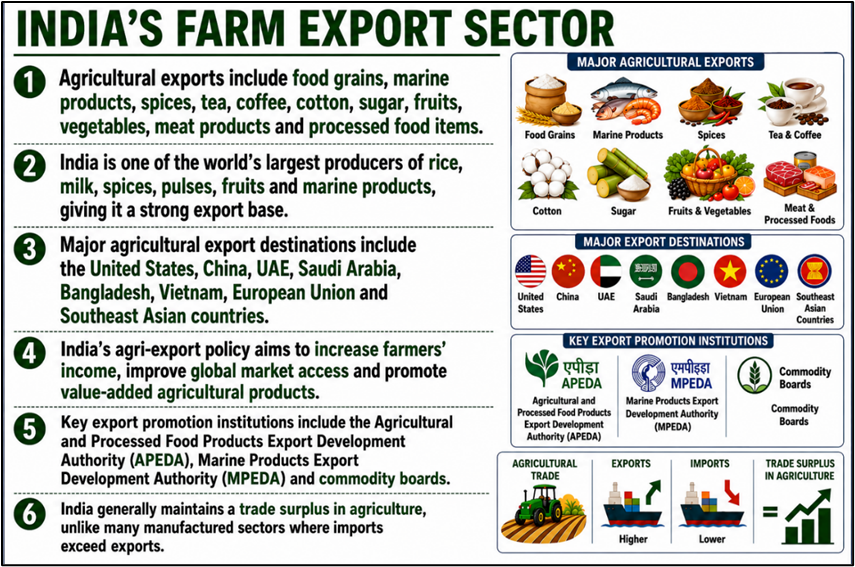
Explanation:
What Exactly is Happening?
- The United States increased tariffs on several imported products under its protectionist trade policies. Such tariffs normally reduce export competitiveness by increasing prices in the importing country.
- Despite these challenges, India’s agricultural exports still grew because exporters successfully diversified markets and products instead of depending excessively on the U.S. market.
- India’s overall agricultural exports increased to more than $53 billion in 2025–26, although the growth rate remained moderate.
Major Performing Agricultural Exports:
- Marine products remained India’s largest agricultural export category due to strong demand in East Asia, West Asia and Europe.
- Buffalo meat exports increased significantly because of rising demand from countries such as Vietnam, Malaysia, UAE and Saudi Arabia.
- Coffee exports performed strongly because global coffee shortages and climate-related disruptions in Brazil and Vietnam increased international prices.
- Basmati rice continued to remain an important export item due to India’s strong comparative advantage in aromatic rice production.
Diversification of Export Markets:
- Indian exporters shifted toward Asian, Gulf and African markets to reduce dependence on Western economies.
- This diversification reduced the economic impact of U.S. tariff barriers and created greater resilience in India’s export sector.
- Processed food exports and value-added agricultural products are increasingly becoming important in India’s export strategy.
Emerging Challenges:
- Agricultural imports, especially edible oils, pulses and fruits, have also increased significantly, narrowing India’s agricultural trade surplus.
- Climate change, global price volatility, sanitary standards and supply-chain disruptions remain major risks for agricultural exports.
- Dependence on a few commodities such as rice and marine products can create export vulnerability in the long term.
Conclusion:
India’s agricultural export sector has demonstrated resilience through market diversification, competitive pricing and strong production capacity. However, sustaining long-term export growth will require better logistics, value addition, quality standards, climate-resilient agriculture and reduced dependence on a few export commodities.
Source: (The Indian Express)
La Excellence IAS Academy, the best IAS coaching in Hyderabad, known for delivering quality content and conceptual clarity for UPSC 2026 preparation.
FOLLOW US ON:
◉ YouTube : https://www.youtube.com/@CivilsPrepTeam
◉ Facebook: https://www.facebook.com/LaExcellenceIAS
◉ Instagram: https://www.instagram.com/laexcellenceiasacademy/
GET IN TOUCH:
Contact us at info@laex.in, https://laex.in/contact-us/
or Call us @ +91 9052 29 2929, +91 9052 99 2929, +91 9154 24 2140
OUR BRANCHES:
Head Office: H No: 1-10-225A, Beside AEVA Fertility Center, Ashok Nagar Extension, VV Giri Nagar, Ashok Nagar, Hyderabad, 500020
Madhapur: Flat no: 301, survey no 58-60, Guttala begumpet Madhapur metro pillar: 1524, Rangareddy Hyderabad, Telangana 500081
Bangalore: Plot No: 99, 2nd floor, 80 Feet Road, Beside Poorvika Mobiles, Chandra Layout, Attiguppe, Near Vijaya Nagara, Bengaluru, 560040