
Paper: GS – III, Subject: Economy, Topic: Economics of Animal Rearing, Issue: Tapping Fisheries in Reservoirs.
Context:
The Union Budget 2026–27 proposes integrated development of fisheries in 500 reservoirs and Amrit Sarovars to enhance income, productivity, and market access for fish farmers. The initiative aligns with India’s broader Blue Economy and rural livelihood enhancement goals.
Key Takeaways:
Background:
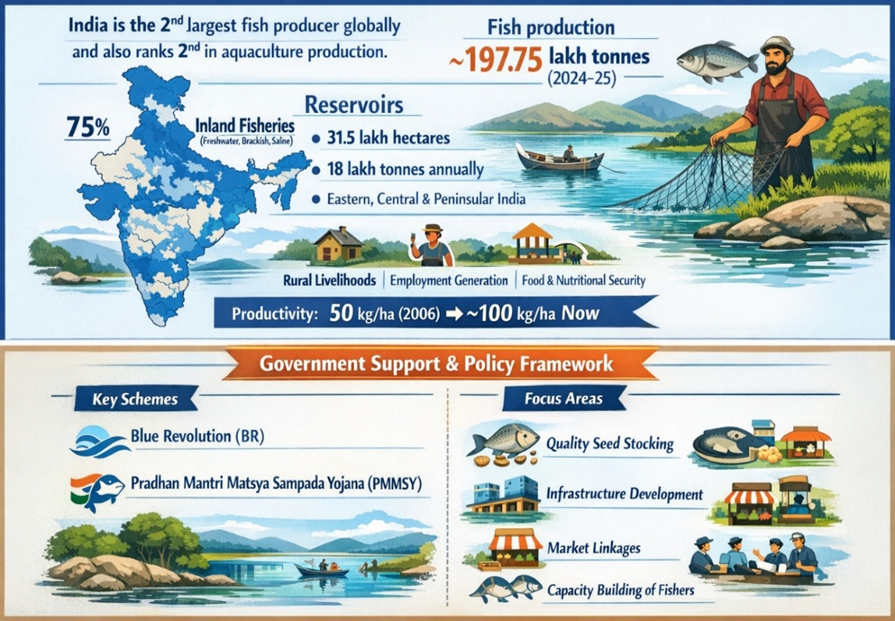
Reservoir Fisheries: Key Interventions:
1. Scientific Stocking & Species Diversification:
- Core species: Indian Major Carps (Catla, Rohu, Mrigal)
- Additional species: Tilapia, Pangasius (based on local demand and ecology)
- Stocking is need-based and participatory, involving beneficiaries
2. Cage Culture Technology:
| Meaning: Use of floating or fixed cages made of synthetic mesh | Features: Allows natural water flow and nutrient exchange Ensures better oxygen availability Facilitates feeding, monitoring, and disease management |
| Types: Rectangular cages (common) Circular cages (increasing adoption) | Outcome: Higher productivity Efficient use of water bodies |
3. Productivity Potential:
Study by ICAR-CIFRI:
Current productivity: ~100 kg/ha
Potential: up to 300 kg/ha
Requires:
Scientific management
Value chain integration
5. Value Chain Approach:
Focus on end-to-end ecosystem development:
Hatcheries
Feed mills
Storage & ice plants
Cold chain logistics
Market infrastructure (auction centres, retail outlets)
Ensures:
Reduced post-harvest losses
Better price realization
6. Cluster-Based Development:
Implemented by National Fisheries Development Board (NFDB)
Example: Reservoir clusters in Madhya Pradesh (Halali & Indra Sagar dams)
Objectives:
Identify sectoral gaps
Improve productivity & processing capacity
Enhance economies of scale through:
Cooperatives
Fish Farmer Producer Organisations (FFPOs)
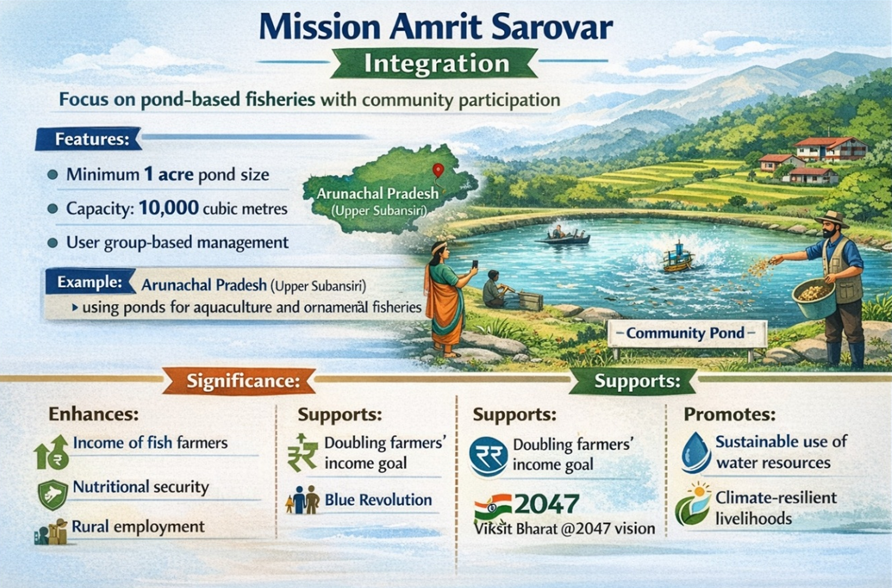
7. Challenges Addressed:
Fragmented ownership of fishing rights
Lack of data and coordination
Weak market linkages
Low productivity levels
Conclusion:
Reservoir fisheries represent an underutilized yet high-potential sector in India’s inland aquaculture. With scientific stocking, cage culture, value chain integration, and institutional support, productivity can be significantly enhanced. The integrated approach under Budget 2026–27 can transform reservoirs into engines of rural growth and fisheries-led economic development.
Source: (The Hindu)
La Excellence IAS Academy, the best IAS coaching in Hyderabad, known for delivering quality content and conceptual clarity for UPSC 2026 preparation.
FOLLOW US ON:
◉ YouTube : https://www.youtube.com/@CivilsPrepTeam
◉ Facebook: https://www.facebook.com/LaExcellenceIAS
◉ Instagram: https://www.instagram.com/laexcellenceiasacademy/
GET IN TOUCH:
Contact us at info@laex.in, https://laex.in/contact-us/
or Call us @ +91 9052 29 2929, +91 9052 99 2929, +91 9154 24 2140
OUR BRANCHES:
Head Office: H No: 1-10-225A, Beside AEVA Fertility Center, Ashok Nagar Extension, VV Giri Nagar, Ashok Nagar, Hyderabad, 500020
Madhapur: Flat no: 301, survey no 58-60, Guttala begumpet Madhapur metro pillar: 1524, Rangareddy Hyderabad, Telangana 500081
Bangalore: Plot No: 99, 2nd floor, 80 Feet Road, Beside Poorvika Mobiles, Chandra Layout, Attiguppe, Near Vijaya Nagara, Bengaluru, 560040