
Paper: GS – II, Subject: Polity, Topic: Rights issues, Issue: Voting Rights in India (Right to Vote).
Context:
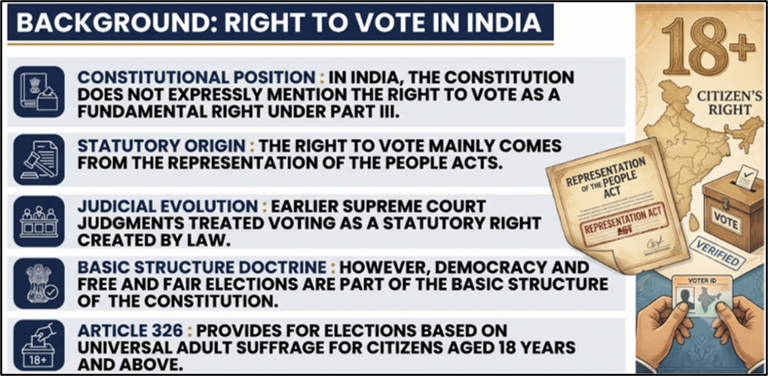
In a democracy, the vote is not just a paper choice; it is the citizen’s share in sovereignty. Recently, the demand to recognise voting as a fundamental right has revived the debate on whether India’s most basic democratic act can remain only a statutory right.
Key Takeaways:
Explanation:
Traditional Legal Position:
- In N.P. Ponnuswami case (1952), the Supreme Court held that election rights are not common law rights but rights created by statute.
- In Jyoti Basu case (1982), the Court stated that the right to elect is neither a fundamental right nor a common law right, but only a statutory right.
- In Kuldip Nayar case (2006), the Court again held that the individual right to vote flows mainly from election laws.
Constitutionalisation of Voting:
- Later judgments slowly expanded the constitutional meaning of voting.
- In Association for Democratic Reforms case (2002), the Court recognised voters’ right to know the criminal, educational and financial background of candidates as part of freedom of speech under Article 19(1)(a).
- In PUCL case (2003), the Court held that freedom of voting means freedom to make an informed choice.
- In the NOTA judgment (2013), the Court held that the right to reject candidates is also part of political expression.
Present Debate:
- A paradox exists because the voter’s right to know, secrecy of ballot and right to reject are constitutionally protected, but the act of voting itself is still treated as statutory.
- Since democracy cannot function without voters, the core right of an eligible citizen to participate in elections deserves stronger constitutional protection.
- However, all procedural details of voting need not become fundamental rights. Parliament can still regulate qualifications, disqualifications, electoral rolls and election procedures.
Conclusion:
Voting is the instrument through which “We, the People” renew democratic legitimacy. Therefore, while procedural regulation may remain statutory, the citizen’s core entitlement to vote deserves constitutional protection.
Source: (The Hindu)
La Excellence IAS Academy, the best IAS coaching in Hyderabad, known for delivering quality content and conceptual clarity for UPSC 2026 preparation.
FOLLOW US ON:
◉ YouTube : https://www.youtube.com/@CivilsPrepTeam
◉ Facebook: https://www.facebook.com/LaExcellenceIAS
◉ Instagram: https://www.instagram.com/laexcellenceiasacademy/
GET IN TOUCH:
Contact us at info@laex.in, https://laex.in/contact-us/
or Call us @ +91 9052 29 2929, +91 9052 99 2929, +91 9154 24 2140
OUR BRANCHES:
Head Office: H No: 1-10-225A, Beside AEVA Fertility Center, Ashok Nagar Extension, VV Giri Nagar, Ashok Nagar, Hyderabad, 500020
Madhapur: Flat no: 301, survey no 58-60, Guttala begumpet Madhapur metro pillar: 1524, Rangareddy Hyderabad, Telangana 500081
Bangalore: Plot No: 99, 2nd floor, 80 Feet Road, Beside Poorvika Mobiles, Chandra Layout, Attiguppe, Near Vijaya Nagara, Bengaluru, 560040